The landscape of payment processing is undergoing a transformative shift, as highlighted in the PYMNTS Intelligence report in collaboration with FIS. Issuers are transitioning from traditional back-end operations to becoming pivotal players in real-time decision-making, leveraging vast amounts of data to enhance transaction outcomes. The report underscores that while issuers possess significant data assets—ranging from credit profiles to transaction histories—the challenge lies in effectively harnessing this information during transactions to mitigate fraud and improve customer experiences. With the rise of digital commerce, the need for dynamic decision-making capabilities has never been more critical.
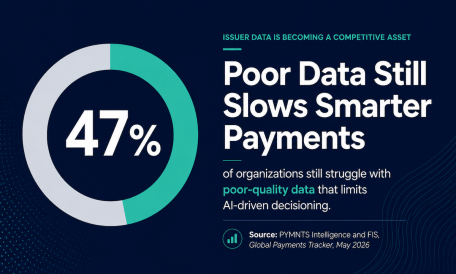
The findings indicate that a staggering 47% of organizations face challenges due to poor-quality data, which hampers the effectiveness of AI-driven decision-making. This issue is particularly pronounced in card-not-present transactions, where issuers are reported to have falsely declined around 15% of legitimate eCommerce transactions, contributing to an estimated $430 billion in lost sales globally. Despite these challenges, 42% of issuers have reported saving more than $5 million in fraud losses through AI implementations, showcasing the technology's potential to reshape the payment landscape.
As traditional systems were primarily designed for reliability and speed, they now require a paradigm shift towards real-time, contextual decision-making. The report reveals that while 55% of organizations have unified a significant portion of their data, many still struggle with data quality. This presents a critical opportunity for issuers to innovate and develop platforms capable of activating data in real-time, thus enhancing their fraud detection and authorization processes. With FIS processing over 73 billion transactions annually across more than 75 countries, the scale at which they operate provides a competitive edge in analytics and fraud prevention.
Looking ahead, issuer processors are poised to become orchestrators of real-time payments, especially in emerging sectors like agentic commerce, where AI could autonomously initiate purchases. This evolution necessitates that issuers validate credentials and authorize transactions seamlessly, without introducing friction. For financial institutions in the Gulf region, this represents a pivotal moment to transform payment processing from a mere record-keeping function into a proactive system that drives action and enhances customer engagement.
The findings indicate that a staggering 47% of organizations face challenges due to poor-quality data, which hampers the effectiveness of AI-driven decision-making. This issue is particularly pronounced in card-not-present transactions, where issuers are reported to have falsely declined around 15% of legitimate eCommerce transactions, contributing to an estimated $430 billion in lost sales globally. Despite these challenges, 42% of issuers have reported saving more than $5 million in fraud losses through AI implementations, showcasing the technology's potential to reshape the payment landscape.
As traditional systems were primarily designed for reliability and speed, they now require a paradigm shift towards real-time, contextual decision-making. The report reveals that while 55% of organizations have unified a significant portion of their data, many still struggle with data quality. This presents a critical opportunity for issuers to innovate and develop platforms capable of activating data in real-time, thus enhancing their fraud detection and authorization processes. With FIS processing over 73 billion transactions annually across more than 75 countries, the scale at which they operate provides a competitive edge in analytics and fraud prevention.
Looking ahead, issuer processors are poised to become orchestrators of real-time payments, especially in emerging sectors like agentic commerce, where AI could autonomously initiate purchases. This evolution necessitates that issuers validate credentials and authorize transactions seamlessly, without introducing friction. For financial institutions in the Gulf region, this represents a pivotal moment to transform payment processing from a mere record-keeping function into a proactive system that drives action and enhances customer engagement.
Source: PYMNTS