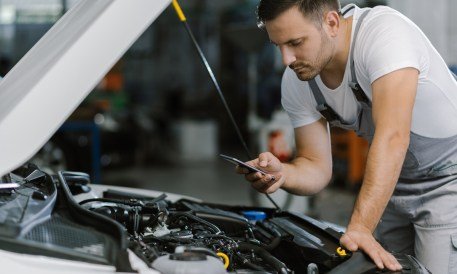
Artificial intelligence is making significant inroads into blue-collar professions, fundamentally altering how workers in manual trades, such as automotive and industrial mechanics, perform their jobs. According to a recent Google report, these workers are utilizing AI to diagnose issues and troubleshoot problems through simple photographs, rather than lengthy text descriptions. This multimodal approach to AI, which integrates images and video, is being adopted at twice the rate of average workplace AI usage, indicating a profound shift in the utility of technology in hands-on occupations. As a result, the trades are experiencing a wage boom, with salaries in construction and mechanical fields rising by 30% to 40% since 2020, significantly outpacing growth in many office-based roles.
The implications of this trend extend beyond immediate productivity gains. With AI now touching 68% of occupations in the U.S., the technology is becoming a critical tool for workers across various sectors, including those traditionally seen as manual labor. While AI is enhancing efficiency and diagnostic capabilities, it is important to note that skilled trades still rely heavily on human judgment and expertise, ensuring that technology serves as a complement rather than a replacement. The correlation between rising wages and increased AI usage suggests that higher earnings may incentivize further adoption of these technologies, creating a feedback loop that could reshape labor dynamics in the trades.
In the broader context, wholesale firms are leading the charge in AI adoption, integrating the technology across multiple business functions. A recent survey highlighted that these companies are not only increasing their AI budgets but also expecting substantial returns on investment over the long term. This trend reflects a strategic shift in how businesses view AI—not merely as an experimental tool but as an essential component of operational infrastructure. As blue-collar workers continue to embrace AI for practical applications on the job, the potential for innovation and efficiency in the Gulf's labor market becomes increasingly apparent, positioning the region for a future where technology and traditional skills coexist harmoniously.
The implications of this trend extend beyond immediate productivity gains. With AI now touching 68% of occupations in the U.S., the technology is becoming a critical tool for workers across various sectors, including those traditionally seen as manual labor. While AI is enhancing efficiency and diagnostic capabilities, it is important to note that skilled trades still rely heavily on human judgment and expertise, ensuring that technology serves as a complement rather than a replacement. The correlation between rising wages and increased AI usage suggests that higher earnings may incentivize further adoption of these technologies, creating a feedback loop that could reshape labor dynamics in the trades.
In the broader context, wholesale firms are leading the charge in AI adoption, integrating the technology across multiple business functions. A recent survey highlighted that these companies are not only increasing their AI budgets but also expecting substantial returns on investment over the long term. This trend reflects a strategic shift in how businesses view AI—not merely as an experimental tool but as an essential component of operational infrastructure. As blue-collar workers continue to embrace AI for practical applications on the job, the potential for innovation and efficiency in the Gulf's labor market becomes increasingly apparent, positioning the region for a future where technology and traditional skills coexist harmoniously.
Source: PYMNTS