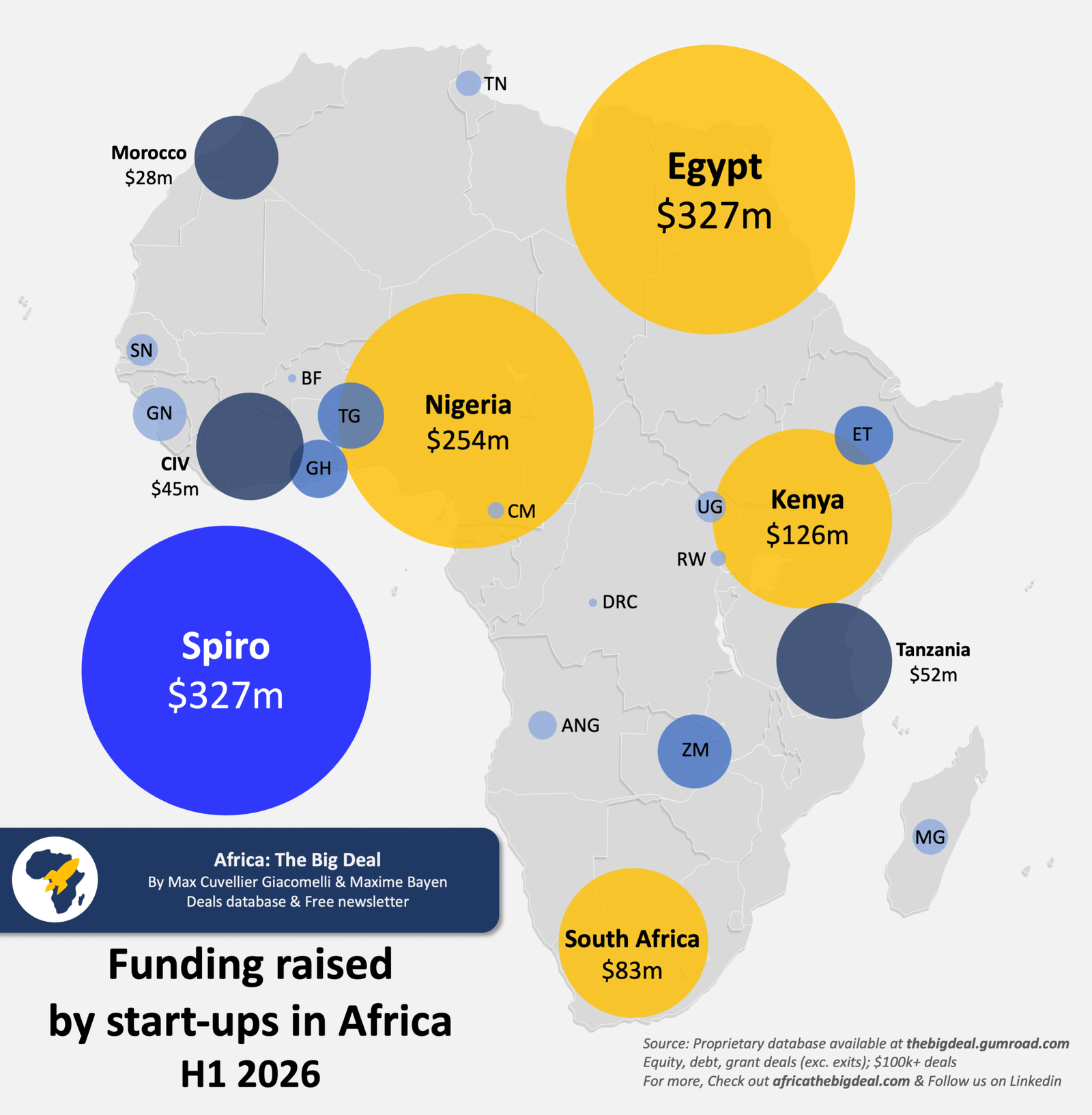
In the first half of 2026, Egypt and Nigeria emerged as the leading recipients of tech funding in Africa, securing US$327 million and US$254 million, respectively, according to a report by Africa: The Big Deal. This capital concentration accounted for 58% of the continent's total funding, with notable contributions from Kenya and South Africa, which raised US$126 million and US$83 million, respectively. However, the overall funding landscape reveals a worrying trend: a significant drop in early-stage transaction volumes, suggesting a tightening venture pipeline across the continent. This shift may reflect a growing investor preference for larger, more established companies over nascent startups, which could have long-term implications for the growth of the tech ecosystem in Africa.
A standout transaction during this period was the US$327 million raised by Spiro, an electric mobility company based in Benin, which received US$270 million in equity and US$57 million in debt. This single deal is noteworthy as it rivals the total funding attracted by all Egyptian startups combined in the same timeframe. Spiro's operations in Kenya, despite its Benin incorporation, illustrate how cross-border dynamics can distort regional funding narratives, particularly as Kenya's apparent decline in funding is put into perspective by this transaction.
When examining pure equity funding, Nigeria led with US$214 million, followed closely by Egypt at US$183 million. The report also highlighted emerging markets such as Tanzania, Côte d'Ivoire, and Morocco, each securing over US$25 million in total capital, indicating that while the major hubs dominate, there is a burgeoning interest in other regions. However, the broader decline in deal volumes, particularly among early-stage startups, raises concerns about the future of venture capital flows in Africa, as investors increasingly favor larger investments in more mature companies.
The first half of 2026 saw 190 ventures raise at least US$100,000, with Nigeria reclaiming the top spot for the highest number of funded ventures after a sluggish performance in the latter half of 2025. This trend underscores a significant shift in market dynamics, as investors are writing larger checks, leaving a noticeable gap in early-stage funding. The implications for startups seeking capital are profound, as they may face increased challenges in securing the necessary funding to scale and innovate in an increasingly competitive landscape.
A standout transaction during this period was the US$327 million raised by Spiro, an electric mobility company based in Benin, which received US$270 million in equity and US$57 million in debt. This single deal is noteworthy as it rivals the total funding attracted by all Egyptian startups combined in the same timeframe. Spiro's operations in Kenya, despite its Benin incorporation, illustrate how cross-border dynamics can distort regional funding narratives, particularly as Kenya's apparent decline in funding is put into perspective by this transaction.
When examining pure equity funding, Nigeria led with US$214 million, followed closely by Egypt at US$183 million. The report also highlighted emerging markets such as Tanzania, Côte d'Ivoire, and Morocco, each securing over US$25 million in total capital, indicating that while the major hubs dominate, there is a burgeoning interest in other regions. However, the broader decline in deal volumes, particularly among early-stage startups, raises concerns about the future of venture capital flows in Africa, as investors increasingly favor larger investments in more mature companies.
The first half of 2026 saw 190 ventures raise at least US$100,000, with Nigeria reclaiming the top spot for the highest number of funded ventures after a sluggish performance in the latter half of 2025. This trend underscores a significant shift in market dynamics, as investors are writing larger checks, leaving a noticeable gap in early-stage funding. The implications for startups seeking capital are profound, as they may face increased challenges in securing the necessary funding to scale and innovate in an increasingly competitive landscape.
Source: Fintech News ME