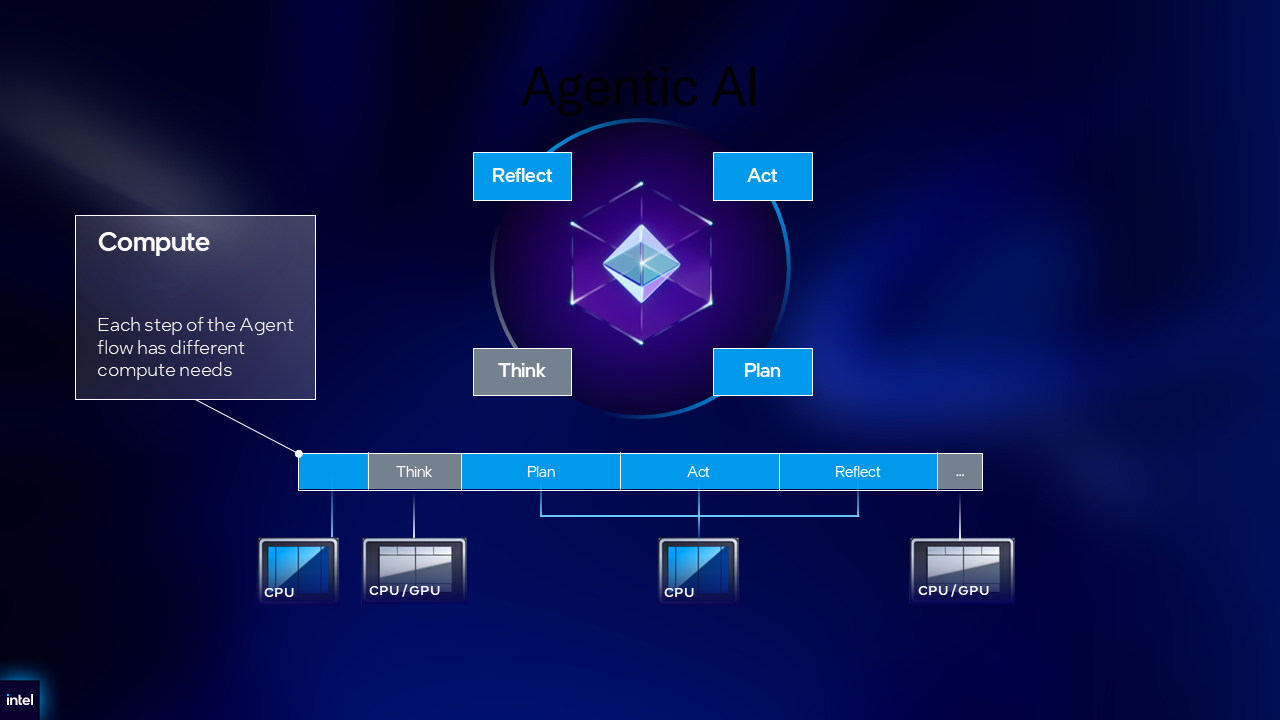
Intel's recent exploration into agentic AI reveals that its true value lies in the ability to automate complex business workflows rather than merely enhancing chatbots. This technology enables software agents to execute tasks across various systems and processes, making them integral to enterprise efficiency. The research underscores that successful implementation of agentic AI requires a comprehensive approach that considers not just inference but also system performance, task orchestration, and data management. Intel's findings suggest that enterprises should focus on metrics such as task success rates and latency to gauge the effectiveness of their AI systems, rather than relying solely on traditional measures like CPU utilization.
The study also introduces the concept of agent density as a critical factor for scaling operations effectively. By normalizing agent counts based on available compute resources, organizations can better assess their capacity to handle multiple agents concurrently. This shift in perspective allows for more informed decisions regarding infrastructure investments, particularly in the context of the Gulf region's growing emphasis on digital transformation and AI integration.
Moreover, Intel advocates for a strategic approach to scaling agentic AI deployments. The preference for a scale-out strategy—adding more systems rather than enhancing existing ones—aligns with the operational characteristics of agentic AI, which often involves bursts of compute-intensive tasks. This strategy not only enhances performance but also supports high availability and cost efficiency, key considerations for enterprises in a competitive market. As organizations in Saudi Arabia and the broader GCC seek to harness AI for improved productivity and governance, understanding these principles will be vital for successful integration and sustained growth in the sector.
The study also introduces the concept of agent density as a critical factor for scaling operations effectively. By normalizing agent counts based on available compute resources, organizations can better assess their capacity to handle multiple agents concurrently. This shift in perspective allows for more informed decisions regarding infrastructure investments, particularly in the context of the Gulf region's growing emphasis on digital transformation and AI integration.
Moreover, Intel advocates for a strategic approach to scaling agentic AI deployments. The preference for a scale-out strategy—adding more systems rather than enhancing existing ones—aligns with the operational characteristics of agentic AI, which often involves bursts of compute-intensive tasks. This strategy not only enhances performance but also supports high availability and cost efficiency, key considerations for enterprises in a competitive market. As organizations in Saudi Arabia and the broader GCC seek to harness AI for improved productivity and governance, understanding these principles will be vital for successful integration and sustained growth in the sector.
Source: MIT Tech Review