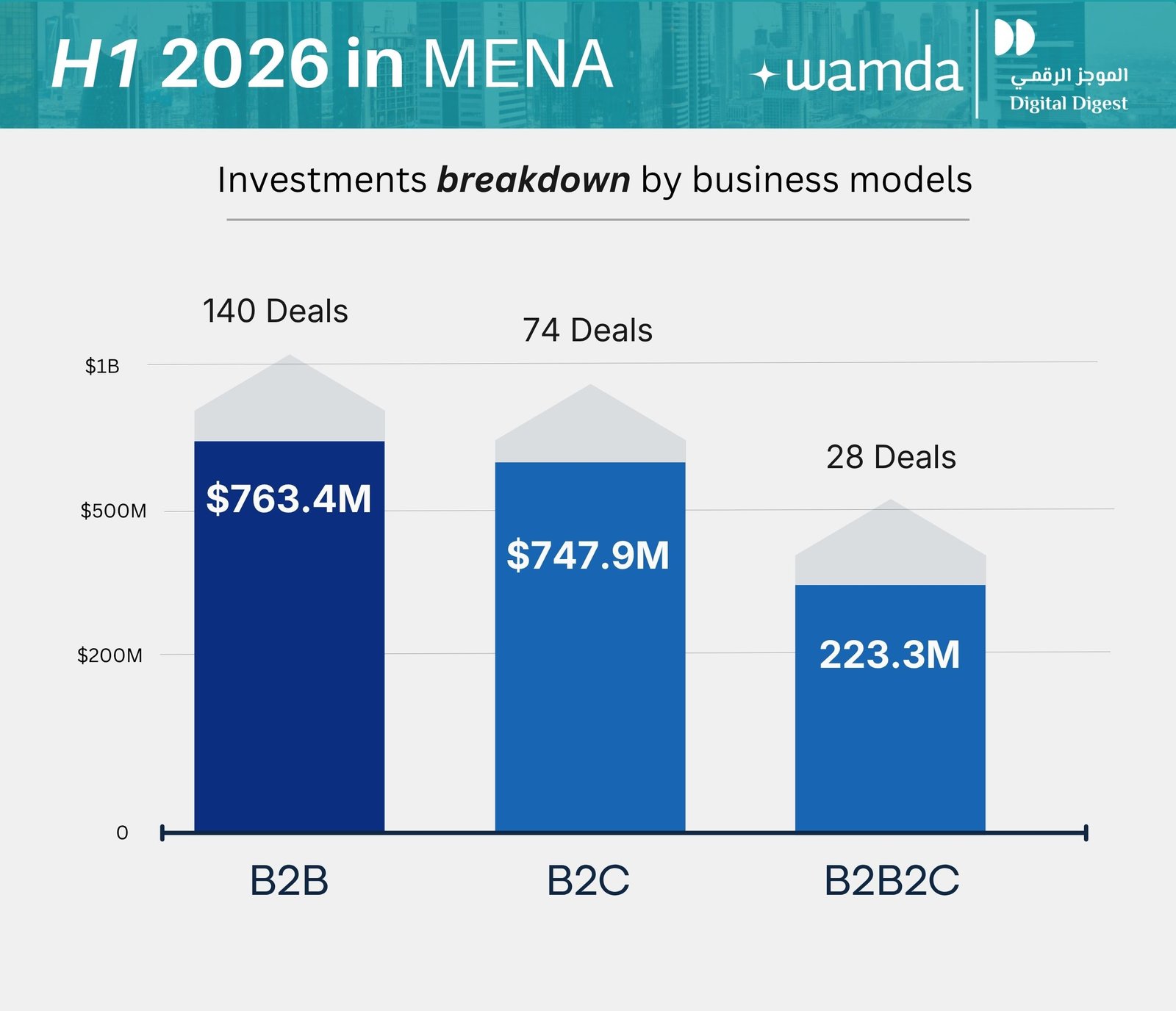
The Middle East and North Africa's startup ecosystem demonstrated resilience in the first half of 2026, attracting $1.7 billion across 242 funding rounds, albeit with an 18% decline from the previous year's $2.1 billion. This decrease in total funding reflects a more selective approach from investors, as deal volume fell by 28% year on year. Notably, the reliance on debt financing diminished, with equity investment gaining prominence, suggesting a recalibration of the market rather than a retreat. Investors are increasingly focusing on established sectors and companies with clear pathways to growth amidst ongoing regional uncertainties.
In the second quarter, MENA startups raised $793.5 million across 104 deals, with the UAE leading the charge by securing $591 million through 37 transactions. Saudi Arabia followed with $102 million from 23 deals, while Egypt garnered $72.6 million across 17 transactions. Logistics emerged as the most significant sector in Q2, raising $300 million through just two deals, highlighting a trend towards fewer but larger investments. Fintech remained a dominant force, attracting $278.6 million across 26 deals, while early-stage startups continued to dominate in terms of transaction volume, despite accounting for a smaller share of total capital raised.
The gender disparity in funding remains stark, with male-founded startups capturing approximately 95% of total capital deployed. Female-founded companies managed to secure a mere $2.5 million, underscoring the ongoing challenges for female entrepreneurs in accessing venture capital. The UAE further solidified its position as the leading startup market in the region, accounting for roughly 70% of all capital invested, driven by a robust fintech sector and a maturing ecosystem that supports later-stage funding.
Saudi Arabia, while experiencing a significant decline in funding compared to its record year in 2025, still benefits from a strong pipeline of founders and institutional investors. Egypt's startup landscape, however, continues to grapple with economic challenges, limiting access to capital and larger funding rounds. Looking ahead, the MENA startup ecosystem appears poised for recovery, contingent on improved regional stability and investor confidence, with several high-profile IPOs and exits potentially reigniting market momentum.
In the second quarter, MENA startups raised $793.5 million across 104 deals, with the UAE leading the charge by securing $591 million through 37 transactions. Saudi Arabia followed with $102 million from 23 deals, while Egypt garnered $72.6 million across 17 transactions. Logistics emerged as the most significant sector in Q2, raising $300 million through just two deals, highlighting a trend towards fewer but larger investments. Fintech remained a dominant force, attracting $278.6 million across 26 deals, while early-stage startups continued to dominate in terms of transaction volume, despite accounting for a smaller share of total capital raised.
The gender disparity in funding remains stark, with male-founded startups capturing approximately 95% of total capital deployed. Female-founded companies managed to secure a mere $2.5 million, underscoring the ongoing challenges for female entrepreneurs in accessing venture capital. The UAE further solidified its position as the leading startup market in the region, accounting for roughly 70% of all capital invested, driven by a robust fintech sector and a maturing ecosystem that supports later-stage funding.
Saudi Arabia, while experiencing a significant decline in funding compared to its record year in 2025, still benefits from a strong pipeline of founders and institutional investors. Egypt's startup landscape, however, continues to grapple with economic challenges, limiting access to capital and larger funding rounds. Looking ahead, the MENA startup ecosystem appears poised for recovery, contingent on improved regional stability and investor confidence, with several high-profile IPOs and exits potentially reigniting market momentum.
Source: Wamda