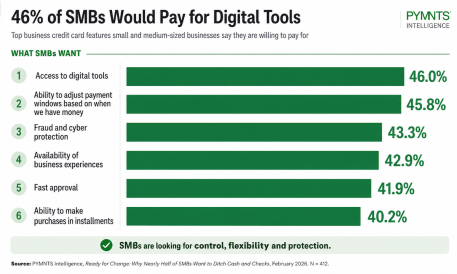
A recent report by PYMNTS, in collaboration with Mastercard, highlights a growing demand among small to medium-sized businesses (SMBs) for advanced digital tools that enhance their financial control and operational efficiency. The survey, which included 412 SMBs in the United States, reveals that nearly half of these businesses are prepared to invest in digital solutions that allow for better management of cash flow, payment timing, and fraud protection. This trend underscores a shift away from traditional payment methods like cash and checks, as SMBs increasingly view credit cards as essential financial management tools rather than mere transactional instruments.
The findings indicate that 63.1% of respondents consider credit cards the most effective means for disputing transactions and securing refunds, while 45.8% express interest in features that enable them to adjust payment schedules based on their cash availability. Furthermore, 43.3% of SMBs are willing to pay for enhanced fraud and cyber protection, reflecting heightened concerns over security in the digital age. Other features such as fast approval processes and the ability to split purchases into installments also received notable interest, particularly among larger SMBs that prioritize control and visibility in their financial operations.
The report also emphasizes the varying priorities across different sectors, with construction firms favoring flexible credit options and speed, while retail businesses lean towards integrated tools and networking opportunities. Despite a strong preference for self-service digital applications, many smaller and rural businesses still value personal support, suggesting that a hybrid model combining digital efficiency with human assistance may be the most effective approach for financial service providers.
For banks, issuers, and fintech companies, this presents a clear opportunity to develop products that align with the practical needs of SMBs. The focus should not be on novelty but rather on delivering solutions that empower businesses to manage their cash flow, mitigate risks, and operate with greater confidence. As SMBs increasingly seek out these digital tools, financial service providers must adapt their offerings to meet this evolving demand.
The findings indicate that 63.1% of respondents consider credit cards the most effective means for disputing transactions and securing refunds, while 45.8% express interest in features that enable them to adjust payment schedules based on their cash availability. Furthermore, 43.3% of SMBs are willing to pay for enhanced fraud and cyber protection, reflecting heightened concerns over security in the digital age. Other features such as fast approval processes and the ability to split purchases into installments also received notable interest, particularly among larger SMBs that prioritize control and visibility in their financial operations.
The report also emphasizes the varying priorities across different sectors, with construction firms favoring flexible credit options and speed, while retail businesses lean towards integrated tools and networking opportunities. Despite a strong preference for self-service digital applications, many smaller and rural businesses still value personal support, suggesting that a hybrid model combining digital efficiency with human assistance may be the most effective approach for financial service providers.
For banks, issuers, and fintech companies, this presents a clear opportunity to develop products that align with the practical needs of SMBs. The focus should not be on novelty but rather on delivering solutions that empower businesses to manage their cash flow, mitigate risks, and operate with greater confidence. As SMBs increasingly seek out these digital tools, financial service providers must adapt their offerings to meet this evolving demand.
Source: PYMNTS